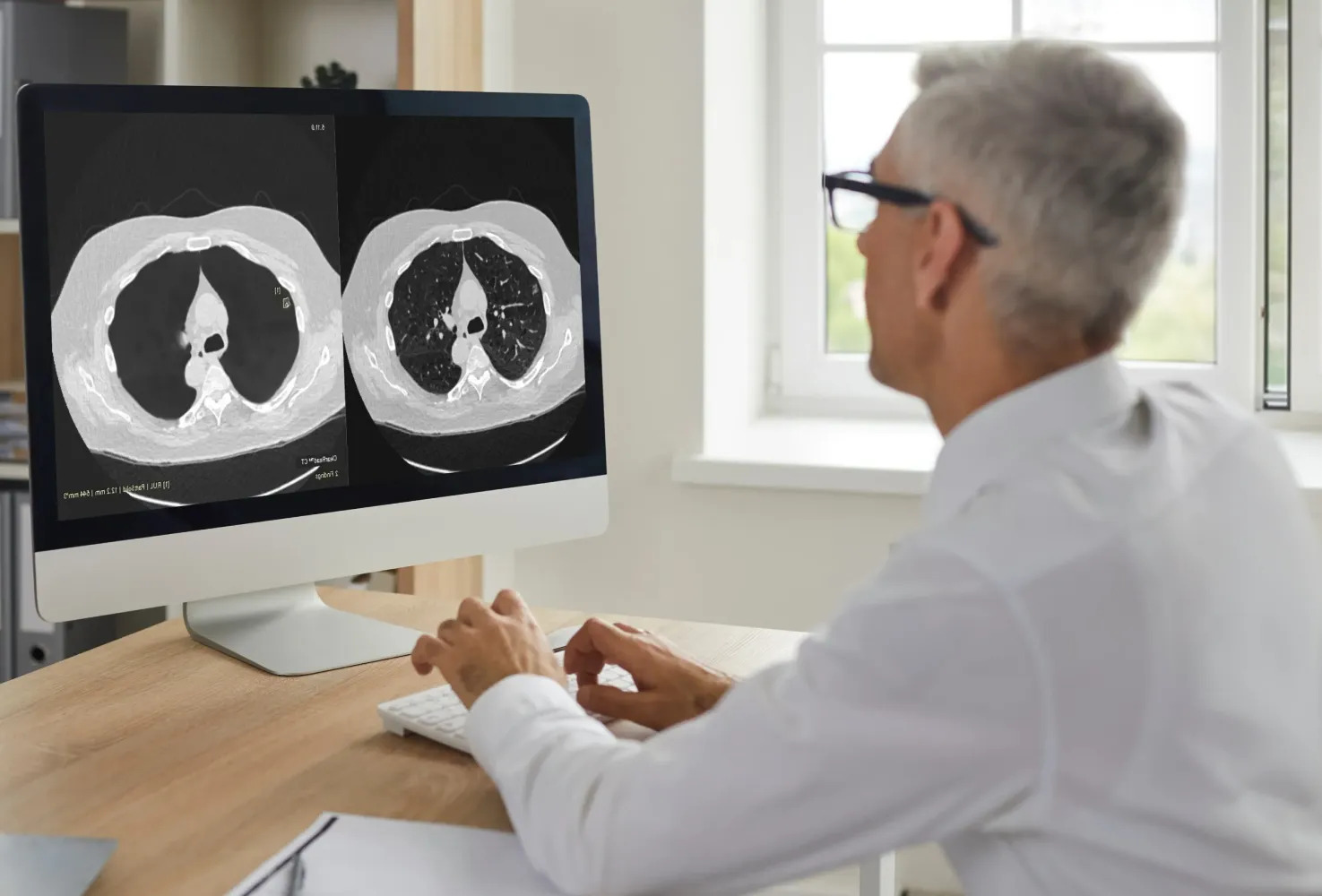
Ideal Series for Processing
Ideal Series:
- Thin-slice over thick-slice (1.0 – 1.25 mm is the sweet spot for our system, functions up to 3 mm).
- Softer reconstruction kernels over excessively sharp ones (Lung kernels are variable).
- Inspiration over expiration.
- Non-contrast is simpler to find nodules than contrast scans (both are useable).
- Minimal artifacts due to motion or metallic shadows.
- Minimal obstructions in the field of view.
Input Requirements:
- No axial rotation – DICOM tag (0020,0037) should either be (1, 0, 0, 0, 1, 0) or (0, 1, 0, 0, -1, 0).
- Slice thickness between 0.5 mm and 3.0 mm with no more than 0.1 mm jitter.
- Slice spacing with no gaps. Overlaps are acceptable.
- Minimum contiguous lung volume of 80 mm.
- Maximum contiguous lung volume of 1067 mm.
- No table height changes.
- No missing slices or gaps due to scan changes.
- Consistent scan characteristics throughout the entire scan.
Note: Cases that do not follow these guidelines will be rejected for processing.
Initial Studies for Processing
Non-Contrast Chest Exams
Lung Cancer Screening Exams
Lung Nodule Follow-ups
Second Stage Studies for Processing
Contrast Exams:
Example:
- Chest CT w/Contrast series.
Caveat:
- Slightly higher chance of false positives.
CTA Exams:
Example:
- Pulmonary Embolism series.
Caveat:
- Slightly higher chance of false positives.
These sorts of exams should be introduced after the radiologists have established proficiency with ideal exam types. Proficiency helps reduce the impact of possible false positives.
Non-Ideal Series for Processing
Partial Lung Series:
Example:
- Head/Neck series – apices may be included.
- Abdomen/Pelvis series – lung bases are frequently included.
Caveat:
- ClearRead CT is more likely to have false positives in the two or three slices before the end of the lung field.
- These can be marked false positives for Detect or just visual residuals in the Vessel Suppress.
Incomplete Field of View (FoV) Series:
Example:
Caveat:
- ClearRead CT may fail to suppress vessels in the entire image.
- ClearRead CT may mark false positives due to the lack of chest walls and full chest field.
These series should only be processed after the radiologists have established proficiency and request them. These are often problematic series for new users.
Series to Avoid Processing
Non-pulmonary nodule-oriented studies:
Examples:
- T-Spine, L-Spine, C-Spine series.
- Coronary Artery Calcification Gated series.
- Biopsy series.
- Implant placement series.
Concerns regarding processing:
- Frequently incomplete field of view.
- Techniques not intended to assist in finding pulmonary nodules.
- These should not be processed without a radiologist’s explicit demands being noted and added to the asset listing.
- Very likely to have residuals or false positives.
These series should never be processed outside the radiologists demanding them.